

By Linny Folau
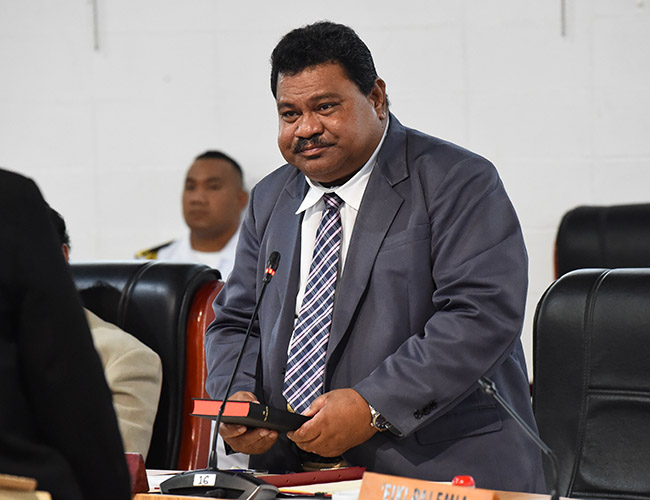
People's Representative for the Ongo Niuas 17 and former Finance Minister, Lata'ifaingata’a Tangimana's appeal against his election being voided was refused by the Appeal Court, after he was found to have engaged in bribery by giving fish to voters ahead of the November 2025 General Election.
The Appeal judges in a judgment on 17 July in Nuku’alofa upheld a Supreme Court judge’s decision, who found beyond a reasonable doubt two allegations of bribery, when the fish were distributed to voters in September 2025, within three months of the November election.
The fish was given out by his sister-in-law, ‘Ilaise Leua, to Mele Folau and Lavinia ‘Afa in Ma’ufanga in order to induce them to vote for him.
Tangimana (appellant) denied any involvement, arguing that ‘Ilaise acted independently and without instruction from him or his wife, Makalita. However, Supreme Court Justice Garlick rejected this claim, after finding that the witnesses evidence were truthful, when they stated that when delivering the fish, ‘Ilaise indicated it was connected to Tangimana’s campaign, saying she had been asked them to remember him in the election.
The judge also found Tangimana’s own evidence lacked credibility.
The Appeal Court agreed with the Supreme Court judge's findings that ‘Ilaise was giving out the fish on behalf of Tangimana, and as an inducment to vote for him.
"One of the diffculties for the appellant is that the main witnesses for the respondent were found to be credible and reliable, while the evidence for the appellant did not reach that standard."
Tangimana argued that the Supreme Court judge had misapplied the law of agency and that there was no direct evidence that the appellant or his wife authorised or instructed any message relating to the fish.
Moreover, he submitted that there was no evidence that his wife concerned herself with the election, and that the fish could have been given for other reasons, such as ordinary cultural generosity or that 'Ilaise had acted independently, among other submissions.
The Court found that these alternative explanations did not arise from the evidence.
The Supreme Court judge found Mele Folau to be a "truthful, accurate and reliable witness", who was not shaken under cross examination. Furthermore, the evidence of Lavinia 'Afa was not challenged during cross examination. The judge also agreed with submissions that her evidence substantially corroborated Mele Folau's account, while noting that it did not require corroboration, stated the Appeal Court.
It then rejected Tangimana's argument of no dicrect evidence that this fish was made on his behalf and for votes.
The Appeal Court stated this was because; Tangimana had visited Mele shortly before the election with 'Ilaise and discussed the election; he admitted that his wife and 'Ilaise supported his election campaign and that both Mele and Lavinia gave evidence that 'Ilaise said that fish came from Makalita and were handed out for them to remember Tangimana's election.
The Appeal Court considered the evidence that 'Ilaise was acting as Tangimana's agent compelling.
Furthermore, the Appeal Court disagreed with Tangimana's argument that Mele's evidence about what 'Ilaise said was hearsay and should not have been relied upon.
Mele gave direct evidence of what 'Ilaise said to her and although part of the statement involved what 'Ilaise allegedly had been told by Makalita, section 35 of the Electoral Act gives the Court flexibility to admit evidence that may assist it in dealing effectively with an election petition.
Furthermore, this case was not primarily dependent on hearsay. There was substantial direct evidence from Mele and Lavinia, together with the circumstances surrounding Lata's later visit, it added.
"It is important to remember that an electoral petition which alleges bribery is not a criminal trial. There is of course the consequence that an elected representative may lose their seat in the Legislative Assembly but, they are not in this process, at least subject to criminal sanctions. So while this court has held that the standard of proof is to the criminal standard of proof beyond reasonable doubt section 35 of the Electoral Act establishes that the court is not bound by the same rules of evidence.
Whether or not hearsay evidence is admitted in proof of bribery will depend on the cogency of the evidence and the part it plays in proving the petitioner's case. Given the need to establish the case beyond reasonable doubt it is difficult to see how a case that is wholly or primarily dependant on hearsay evidence could ever succeed.
That however is not the case here."
The Court of Appeal then refused the appeal and ordered that Tangimana's election remain void.
The original petition was brought against Tangimana by 'Aisake Finau.