


An El Niño, officially declared for Tonga for the next 3 to 6 months, is expected to bring significant changes to Tonga’s weather patterns and tropical cyclone activity,
Tonga Meteorological Services declared the El Niño on 19 June following sustained warming of sea surface temperatures across the central and eastern equatorial Pacific and corresponding changes in the coupling effect of ocean-atmospheric circulation.
El Niño is a naturally occurring climate phenomenon that influences weather and climate patterns for Tonga, across the Pacific region and globally.
"Its development is expected to affect Tonga over the next three to six months, and could extend into next year, bringing significant changes to Tonga’s temperatures, rainfall patterns, drought status and tropical cyclone activity," Tonga Met stated.
After monitoring the state of the El Niño Southern Oscillation (ENSO) in the past five months leading up to the week ending 7 June 2026, Tonga Met noted that the Niño 3.4 index value was +0.81 ºC, just above the El Niño threshold (+0.80 ºC).
The latest relative Niño3.4 index value for the week ending 14 June 2026 was +0.92 °C, above the El Niño threshold (+0.80 °C). A positive Sea Surface Temperature (SST) anomaly of 0.12 °C.
"This is clear evidence that El Niño has established and currently underway in the Tropical Pacific."
All climate dynamical model forecast, and analysis used by the Tonga Met shows that the Tropical Pacific to continue warming in the next 3 to 6 months from July 2026 toJanuary 2027.
Based on Tonga Meteorological Service current climate outlooks and forecasts, Tonga is likely to experience to following impacts of El Niño:
- The onset of below average rainfall and drier conditions for all island divisions of Tonga in the next 3 to 6 months.
- High likelihood for drought conditions to affect all island divisions of Tonga in the next 3 to 6 months. Especially for island divisions who are primarily dependent on rain water and water tank collections.
- High likelihood for Tropical Cyclone (TC) activities to affect Tonga with increased frequency of Severe Tropical Cyclones (category 3 to 5) occurring in Tonga for the upcoming Tropical Cyclone season (November 2026 - April 2027).
- For this upcoming Tropical Cyclone season (November 2026 - April 2027) and the given established El Niño event forecasted to prolong into our TC Season. It should be noted that during El Niño events, Tonga on average encounters about 2 to 4 Tropical Cyclones with the possibility of at least 2 reaching Severe TC strength (Categories 3 to 5).
- An increased likelihood for marine heat wave conditions and coral bleaching impacts to affect all of Tonga waters in the next 3 to 6 months.
Response planning
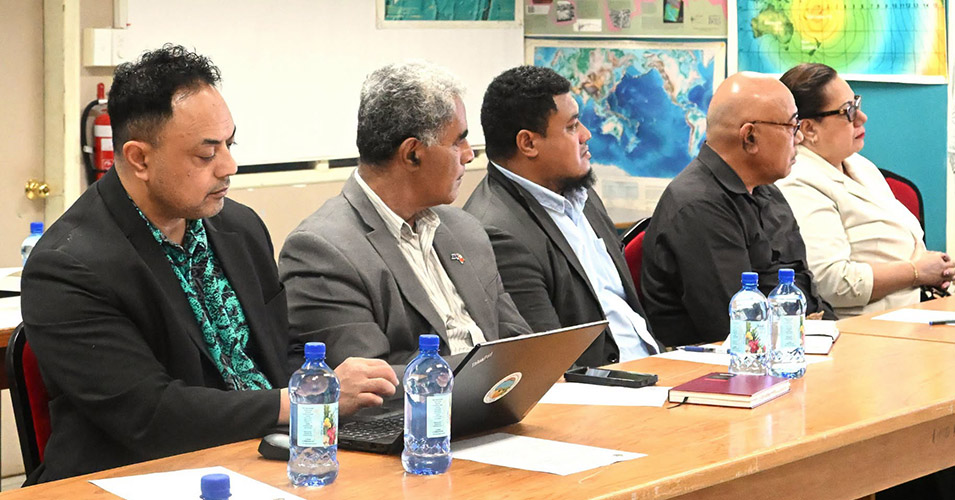
Following the El Niño declaration, the National Disaster Risk Management Committee (NDRMC) convened on 22 June 2026, to strengthen preparedness and response planning in response to El Niño impacts for Tonga across government ministries, clusters, agencies and into community levels.
The meeting was chaired by the CEO for the Ministry of MEIDECC, Sione ‘Akauola. The meeting brought together executive officers as cluster leads and senior government officials responsible for disaster risk management and national preparedness across Tonga.
The El Niño meteorological briefing and outlook presentation delivered by the Director of TMS, Laitia Fifita, provided an update on expected climate/weather conditions and variabilities associated with El Niño and their potential impacts on Tonga over the coming months. Discussions focused on strengthening preparedness measures, enhancing coordination among government agencies, and ensuring that sectoral and cluster plans are aligned to address emerging risks.
One of the key highlights in this El Niño meteorological briefing and outlook presentation delivered by the Director of TMS, focused on the ‘impacts’ of El Niño for Tonga, especially the prediction for below average rainfall for Tonga and the high likelihood for prolonged drought conditions for Tonga for the next 3 to 6 months.
NDRMC members reaffirmed the importance of proactive planning and a whole-of-government approach to current warnings that are in place as issued by the TMS. Immediate drought preparedness and response planning/actions was agreed by all NDRMC members to be implemented.
The National Disaster and Risk Management Committee will meet again on Tuesday, 30 of June 2026 to further discuss and to implement cluster drought response plans for Tonga.