

By Katalina Siasau
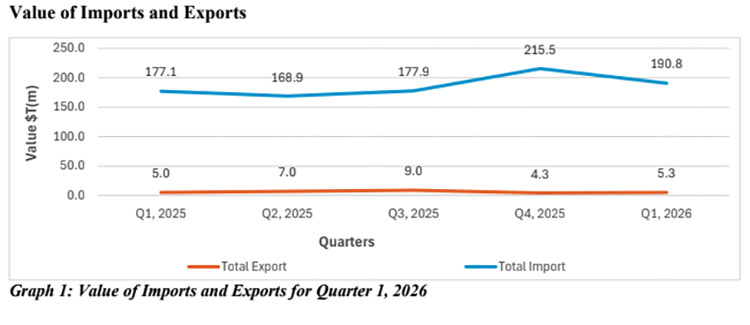
Imports continues to outweigh exports on average as Tonga recorded a trade deficit of T$185.5 million in the first quarter of 2026, according to the Tonga Statistics Department (TSD).
The total imports for the first quarter of 2026 stood at T$190.8 million of total imports. On the other hand, the total exports for the first quarter of 2026 stood at only T$5.3 million, comprised of domestic exports worth T$3.2 million (60.0%) and re-exports worth T$2.1 million (40.0%).
A $40.7 million or 21.3% of the imports were miniral products, reflecting Tonga’s heavy reliance on mineral products, especially fuel.
This was followed by beverages, spirits and tobacco, which amounted to $30.4 million or 15.9%, live animal products worth $29.1 million (15.2%), then followed by machinery, mechanical, and electrical appliances worth $22.9 million (12.0%) and then vehicles, aircraft & associated transport equipment worth $16.1 million (8.4%).
Meanwhile, Tonga’s top principal domestic exports in the first quarter were led by root crops such as cassava, taro, yams, and other root crops totaled to $1.3 million (40.0%). This was then followed by kava which amounted to $1.1 million (33.6%) and fish at $0.6 million (17.6%).
These three major domestic products summed up to 91.2% of the total domestic exports for the first quarter of 2026.
The top destinations for Tonga’s exports for the first quarter of 2026 was led by the United States of America amounted to $2.5 million (46.1%). New Zealand ranked second amounted to $1.3 million (25.1%), followed by Australia $0.6 million (12.2%), American Samoa at $0.6 million (5.6%) and Taiwan, Province of China, at $0.3 million (5.1%).
New Zealand was the main leading source of imports, contributing $47.9 million (25.1%) of total imports in the first quarter of 2026. Singapore ranked second, contributing $35.2 million (18.4%), followed by People’s Republic of China with $26.2 million (13.7%), Australia with $19.0 million (10.0%), and Fiji at $15.3 million (8.0%).