

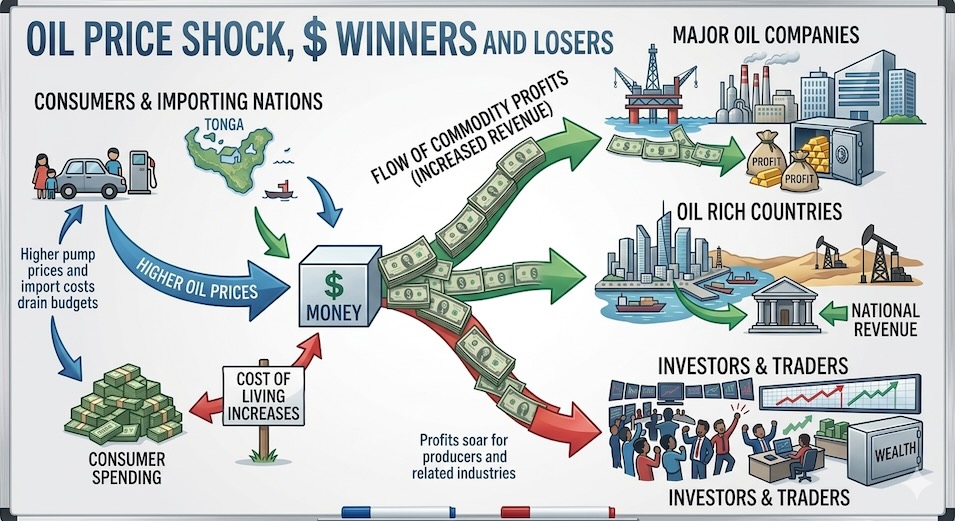
Oil price shocks create windfall profits for oil companies, oil rich countries, investors and traders, and the super-rich. The losers are consumers and importing nations. Infographic generated by AI. Image: Matangi Tonga.
By Katalina Siasau
The conflicts in the Middle East continue to affect Pacific nations, including Tonga, driving up inflation and slowing economic growth. The impact of the resulting energy crisis is expected to cost the Tongan government between $40 million and $50 million, according to the National Budget Statement FY2027.
The sharp rise in fuel prices, temporary fuel management measures, and possible supply disruptions are expected to affect economic activity across several sectors, particularly transport and other fuel-dependent industries.
The Budget Statement said that under more severe scenarios, prolonged disruptions could significantly affect economic activity, with Tonga's GDP projected to contract by around 4.0%.
According to the budget, this would be a larger decline than that experienced during the COVID-19 period.
“The indicative fiscal envelope for the energy crisis is estimated to range from approximately $11.0m to near or over $120.0m depending on the severity and duration of the disruption, based on the latest GDP projections,” the budget stated.
Fuel prices have increased significantly since April, placing immediate pressure on households and government finances.
Fuel supply conditions also remain uncertain due to continuing geopolitical developments in the Strait of Hormuz.
Tonga’s domestic onshore fuel storage capacity is estimated to cover approximately two weeks of demand, while offshore reserves in Fiji provide an additional buffer of up to two months.
Revenue loss
Excise tax collections are projected to decline following two consecutive fuel price increases in April and May, both of which are expected to have reduced fuel demand. For FY2027, fuel excise revenue is expected to decrease substantially. Under the central scenario, the full-year impact is estimated to result in a 10.0% decline in excise revenue compared with normal conditions.
Under a worst-case scenario, the decline in excise tax collections could cause the domestic revenue-to-GDP ratio to fall close to, or potentially below, the benchmark level of 22.0%.
An estimated $14 million decline in government revenue in the 2026/2027 financial year, is expected as an impact of the energy crisis. This brings the total cost to the national budget to between $40 million and $50 million.
To manage this, the government may need to rely on development partner support, domestic borrowing, cash reserves, and potentially a Supplementary Budget.
Emergency response
To support the emergency response to fuel disruptions and other unforeseen events, the government has allocated $31.8 million in targeted funding measures for FY2027.
These measures include:
- $18 million in electricity subsidies
- $1 million in contingency funding to respond to worsening or prolonged impacts;
- $5 million to fund a 3.0% Cost-of-Living Allowance for all civil servants in response to increased living costs resulting from the energy crisis;
- $3.2 million in subsidies for domestic airline Lulutai;
- $3.7 million in subsidies for domestic shipping vessels; and
- $0.9 million for a one-off top-up payment for elderly and disability welfare recipients.
The FY2027 has a budget deficit of $38.1 million which will be financed through $35 million in new domestic bond issuance and a $3.1 million drawdown from the government cash reserves.
The 2026/2027 Government Budget was passed by the Legislative Assembly of Tonga on 18 June. The total budget amounts to $949.4 million, of which $735.2 million is in cash and $214.2 million is in the form of in-kind contributions committed by development partners.