

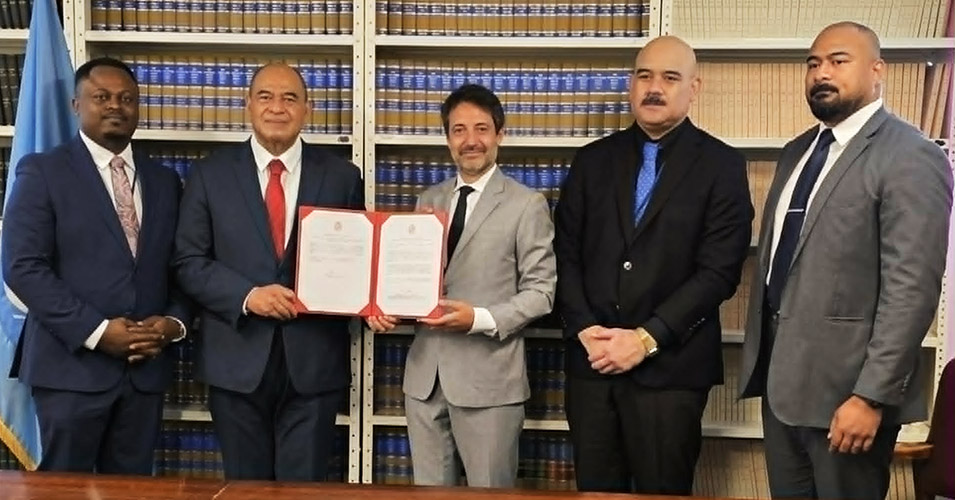
The Kingdom of Tonga has signed three major United Nations treaties aimed at banning nuclear weapons and nuclear testing, while strengthening the protection of marine biodiversity in international waters.
The Permanent Mission of Tonga to the United Nations said the treaty actions reaffirm the Kingdom's commitment to international peace, security, environmental stewardship and the rule of law.
On behalf of Tonga, Ambassador and Permanent Representative to the United Nations, HE Viliami Vaʻinga Tōnē, signed and deposited the Instrument of Ratification to the Comprehensive Nuclear-Test-Ban Treaty (CTBT), signed and deposited the Instrument of Accession to the Treaty on the Prohibition of Nuclear Weapons (TPNW), and deposited the Instrument of Ratification to the Agreement under the United Nations Convention on the Law of the Sea on the Conservation and Sustainable Use of Marine Biological Diversity of Areas beyond National Jurisdiction (BBNJ Agreement), commonly known as the High Seas Treaty.
The ceremony was officiated by Chief of the United Nations Treaty Section, David Nanopoulo, at the United Nations Treaty Section in New York on 7 July 2026. Staff of Tonga's Permanent Mission to the United Nations, together with representatives of the CTBT Organization and the TPNW Organization, also attended.
Speaking during the ceremony, Ambassador Tōnē described the treaty actions as "an important milestone in Tonga's enduring commitment to the purposes and principles of the Charter of the United Nations and the international rule of law."
He said that for a Small Island Developing State such as Tonga, "lasting peace, international security, healthy oceans and nuclear disarmament are inseparable from sustainable development and the well-being of present and future generations."
The Comprehensive Nuclear-Test-Ban Treaty prohibits all nuclear weapon test explosions and any other nuclear explosions.
The Permanent Mission said that by ratifying the treaty, Tonga joins the overwhelming majority of the international community in supporting efforts to prevent nuclear testing and advance global peace and security.
Tonga also acceded to the Treaty on the Prohibition of Nuclear Weapons, the first legally binding international agreement to comprehensively prohibit nuclear weapons. The accession coincided with the ninth anniversary of the treaty's adoption and made Tonga the 100th state to undertake a treaty action under the agreement. International stakeholders recognised the milestone as strengthening the global movement towards a world free of nuclear weapons.

The Kingdom also ratified the High Seas Treaty, which establishes the first comprehensive international framework for the conservation and sustainable use of marine biodiversity in areas beyond national jurisdiction.
The Permanent Mission said Tonga's ratification reflects its role as a large ocean state and reaffirms the Kingdom's longstanding stewardship of the oceans. It also reinforces Tonga's commitment to effective ocean governance and international cooperation to protect marine ecosystems for present and future generations.
The Permanent Mission said the three treaty actions demonstrate Tonga's commitment to multilateralism, international cooperation and a rules-based international order, while contributing to a safer, more peaceful and more sustainable world and safeguarding the health of the oceans for future generations.