

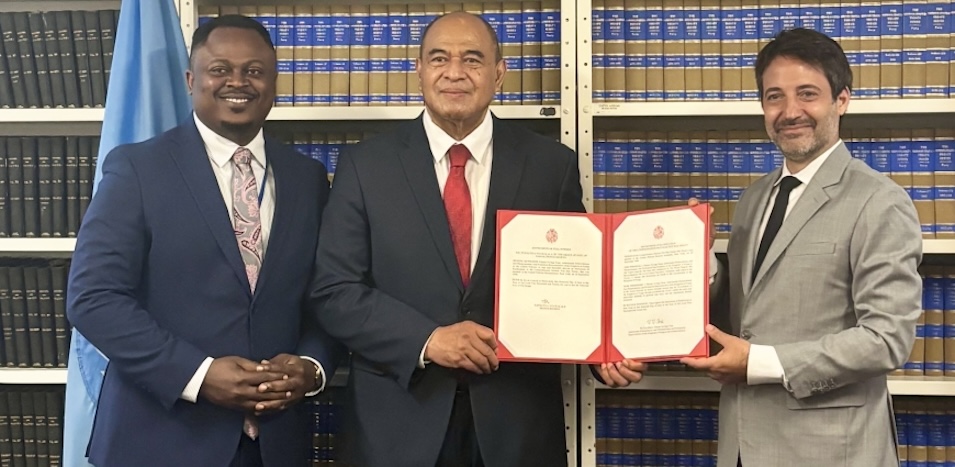
Tonga has ratified the Comprehensive Nuclear-Test-Ban Treaty (CTBT), becoming the 179th State to do so and completing universalisation of the Treaty across the Pacific region. For a part of the world deeply impacted by nuclear testing, it is a milestone long in the making.
The ratification was formalised on 7 July 2026 at a ceremony at United Nations Headquarters in New York, attended by David Nanopoulos, Chief of the Treaty Section at the UN Office of Legal Affairs, Permanent Representative of the Kingdom of Tonga to the United Nations, Ambassador Viliami Va’inga Tōnē, and CTBTO Senior Liaison Officer, Charles Abechi Oko.
Robert Floyd, Executive Secretary of the Comprehensive Nuclear-Test-Ban Treaty Organization (CTBTO), welcomed the ratification.
“Tonga’s ratification is a proud moment for the Pacific and a meaningful contribution to the global effort to ban nuclear test explosions for good. The Kingdom has long stood on the right side of this issue: as a party to the Treaty of Rarotonga, as a consistent voice for non-proliferation and disarmament, and as a country that understands how nuclear testing has impacted this region. I am deeply grateful to the many Tongan officials and regional partners who worked to bring this moment about,” he said.
Ambassador Va’inga Tōnē reflected on the significance of the step.
“ For Tonga, this is not simply a legal formality. It is a statement of who we are and what we stand for. The Pacific has felt the pain of nuclear testing. Ratifying the CTBT is our contribution to ensuring that no one, anywhere, has to go through that again,” he said.
UN High Representative for Disarmament Affairs, Izumi Nakamitsu, also underscored the Treaty's importance.
“The CTBT is an integral part of the global disarmament and non-proliferation architecture. It embodies a simple but vital truth: nuclear tests must never be allowed – not even one,” he said.
Tonga’s ratification is the result of sustained engagement between States Signatories, regional partners, the CTBTO and Tongan leadership over many years.
This step reflects the strong commitment of HRH Tupouto'a Ulukalala, Prince Regent of the Kingdom of Tonga, to international peace and security, and to the leadership it requires. Over the years, Floyd has met regularly with senior officials and members of the Tongan Government, including a mission to the country in May 2025, when Secretary for Foreign Affairs, Viliami Malolo, reaffirmed the Kingdom's support for the CTBT and its engagement with the Treaty.
The CTBTO (Comprehensive Nuclear-Test-Ban Treaty Organization), an international body based in Vienna, Austria, stated that Ambassador Tone, who delivered the instrument of ratification in New York, has also been a steadfast champion of non-proliferation and disarmament.
At the 80th session of the United Nations General Assembly in September 2025, the CTBTO head met with then-Prime Minister ʻAisake Valu Eke. Earlier this year in April, the Executive Secretary met with Ambassador Va’inga Tōnē on the sidelines of the NPT Review Conference in New York, shortly before Tonga confirmed its ratification.
Tonga is a party to the Treaty of Rarotonga, which established the South Pacific Nuclear-Free Zone in 1985, the second such zone in a populated area of the world, prohibiting the manufacture, stationing, and testing of nuclear explosive devices in member territories. Tonga is also a State Party to the Treaty on the Non-Proliferation of Nuclear Weapons (NPT).
With Tonga's signature and ratification, the CTBT now counts 188 States Signatories and 179 ratifying States. Within the Organization’s broader SEAPFE grouping, which covers South-East Asia, the Pacific and the Far East, just two countries have yet to ratify.
Background: The Comprehensive Nuclear-Test-Ban Treaty (CTBT) bans all nuclear explosions everywhere, by everyone, and for all time. Adherence to the Treaty is nearly universal, with 188 signatories and 179 ratifying States. To enter into force, the Treaty must be ratified by all 44 States listed in its Annex 2, for which nine ratifications are still required.
The CTBTO has established an International Monitoring System (IMS) to ensure that no nuclear test explosion goes undetected. Currently, 307 certified facilities - of a total of 337 when complete - are operating around the world, using four main technologies: seismic, hydroacoustic, infrasound and radionuclide.
The data collected by the IMS has also been used for disaster mitigation such as earthquake monitoring and tsunami warning, as well as research into fields as diverse as whale migration, climate change and the prediction of monsoon rains.
(You can learn more about the Treaty and the Organization at www.ctbto.org and @CTBTO on X, Facebook, and LinkedIn.)